

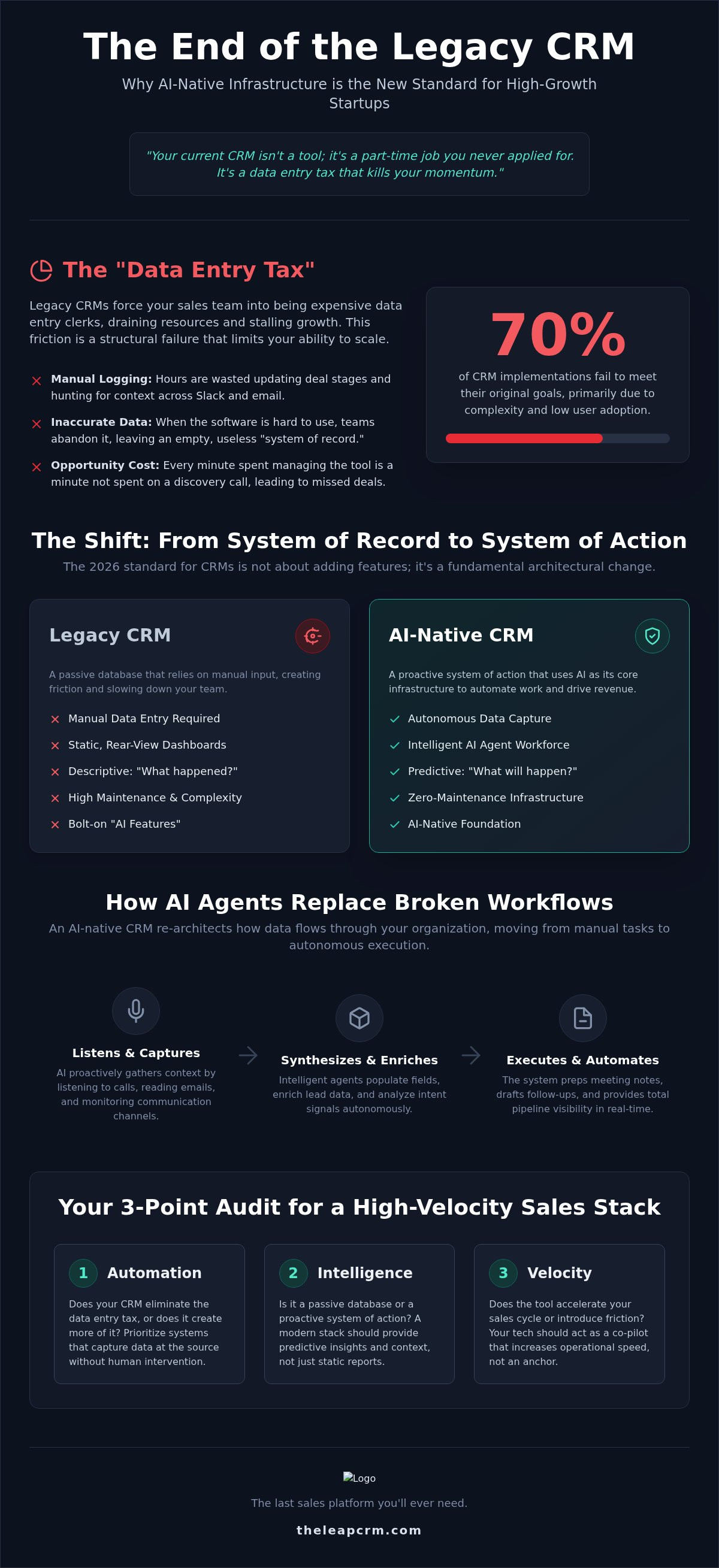
Your current CRM isn't a tool; it's a part-time job you never applied for. You spend your mornings chasing Slack threads, your afternoons logging emails, and your evenings guessing at sales forecasts. It's a data entry tax that kills your momentum. Legacy systems were built for record-keeping, not for closing deals. Selecting an AI CRM for startups is no longer about adding a few clever features to a 2010-era database. It's about replacing broken workflows with a system that actually works for you.
You know the frustration of a fragmented pipeline where leads vanish into the digital noise. You need to scale your sales stack without doubling your headcount. This article explores why AI-native infrastructure is the only logical path forward for high-growth teams. We'll show you how to move from manual tracking to automated execution. You'll discover how The Leap CRM Platform leverages AI agents to provide total pipeline visibility and automated follow-ups. Stop managing rows of data. Start closing the deals that matter.
Key Takeaways
- Eliminate the "data entry tax" that drains your sales team. Legacy systems stall growth. Modern infrastructure accelerates it.
- Define the 2026 standard for an AI CRM for startups. Move beyond passive databases to a proactive system of action.
- Trade static dashboards for autonomous AI agents. Automate meeting prep, lead context, and follow-ups to keep your pipeline moving.
- Use our three-point checklist to audit your sales stack. Prioritize operational velocity over feature bloat to ensure your tech scales.
- Explore the logic-first architecture of the Leap CRM Platform. Build a high-velocity pipeline that closes deals instead of just tracking them.
The Data Entry Tax: Why Legacy CRMs Fail Startups
Legacy sales software is a trap. It prioritizes the database over the deal. For a high-velocity team, this creates a "data entry tax" that drains resources and kills momentum. You hired sales reps to sell. Instead, you've turned them into expensive data entry clerks. They spend hours manually logging emails, updating deal stages, and hunting for context across Slack and email threads. This isn't just inefficient; it's a structural failure that limits your ability to scale.
Research suggests that roughly 70% of CRM implementations fail to meet their original goals. The primary culprit is complexity. Traditional platforms are over-engineered for enterprise compliance, not startup speed. They require constant maintenance and manual input to stay relevant. When the software is harder to use than the actual work, your team will abandon it. You end up with a "system of record" that is empty, inaccurate, and ignored.
The Friction Point: Manual vs. Automated Logic
The "friction gap" is the distance between a sales conversation happening and that conversation being recorded. In legacy systems, this gap is massive. Manual logging leads to "dark data." This is critical information that lives in a rep's head or a private message but never reaches your pipeline. Deals stall because the context is missing. High-performing reps find clunky UIs insulting. It is a psychological toll that leads to burnout. An AI CRM for startups must bridge this gap by capturing data at the source without human intervention.
The Cost of 'Good Enough' Software
Settling for "good enough" software kills your Series A velocity. Every minute spent updating a field is a minute not spent on a discovery call. The opportunity cost is staggering. You aren't just paying for a subscription; you're paying for the deals you miss while your team manages the tool. Many legacy providers now offer "AI features" to stay relevant. Don't be fooled. These are often bolted-on additions to outdated, 2010-era code. They don't fix the underlying logic of the platform.
A true AI CRM for startups is built on an AI-native foundation. It doesn't just add a chatbot to a sidebar; it rearchitects how data flows through your organization. Efficiency isn't a feature you can toggle on. It is the infrastructure itself. If your CRM requires a manual to operate and a full-time admin to maintain, it isn't a tool. It's an anchor.
What is an AI-Native CRM? Defining the 2026 Standard
An AI-native CRM is not a database with a chatbot pinned to the sidebar. It is a fundamental shift in software architecture. In legacy systems, AI is a "feature" you pay extra for. In the 2026 standard, AI is the infrastructure itself. It is the primary interface. You don't navigate menus to find data; you ask the system for outcomes. This is the evolution from a "System of Record" to a "System of Action."
Traditional software waits for you to input data. An AI CRM for startups does the opposite. It proactively gathers context. It listens to calls, reads emails, and monitors Slack. It populates fields autonomously. This eliminates the "guessing" that plagues startup forecasting. The result is a system that is predictive rather than descriptive. It doesn't just tell you what happened last week. It tells you what will happen next month.
From Databases to Intelligent Agents
The modern sales stack has moved beyond static rows and columns. Intelligent agents are the new workforce. These agents handle the heavy lifting of lead enrichment and intent signaling. They don't just find an email address. They analyze a prospect's recent LinkedIn activity and financial reports to determine if they are ready to buy. They prep your meeting notes before you even open your laptop.
An AI-native CRM is an autonomous revenue engine that synthesizes raw data into closed deals without manual intervention.
The Infrastructure of Speed
There is a critical distinction between being cloud-native and AI-native. Cloud-native means your data is stored online. AI-native means your data is alive. It is constantly processing and syncing in real-time. This is the baseline for startup survival. The "weekly pipeline review" is a relic of the past. Why wait for a meeting to see your numbers? With The Leap CRM Platform, you have live visibility into every deal stage at every second.
Velocity requires logic, not just storage. When your CRM acts as a co-pilot, you stop fighting the tool and start fighting for market share. Real-time synchronization ensures that no lead grows cold. It creates a single source of truth that actually stays true. This is how you scale without adding headcount. You don't need more managers; you need better infrastructure.
Why Startups Need AI Agents, Not More Dashboards
Dashboards are graveyard reports. They tell you what you missed, where you stalled, and why you're behind. Startups don't need reports; they need movement. An AI CRM for startups replaces the "System of Record" with a "System of Action." Instead of staring at a colorful chart of a declining pipeline, an AI agent proactively fixes it. It identifies the friction. It suggests the remedy. It executes the task. This is the difference between watching the game and playing it.
This shift is the bridge between founder-led sales and a scalable machine. Founders often stay in the sales seat too long because they are the only ones with the context. They know the nuances that a database can't capture. AI agents bridge this gap. They capture that nuance. They allow the founder to delegate without losing the soul of the sale. It transforms sales from a manual craft into repeatable infrastructure.
The Autonomous Sales Assistant
The boring parts of sales are where deals go to die. Meeting prep, follow-ups, and logging are the first things to slip when you're busy. AI agents don't forget. They draft hyper-personalized outreach in seconds. They scan a prospect's latest funding rounds, LinkedIn posts, and industry news. Imagine waking up to a full dossier on your 9:00 AM call. The agent has already logged the previous interaction, updated the deal stage, and drafted the follow-up email. You get 4 hours back every day. That is half a work week returned to your calendar.
Scaling Without the Headcount
Traditional scaling is linear. More deals require more reps. This is a slow, expensive way to grow. AI-native tools provide non-linear leverage. One rep supported by AI CRM for startups infrastructure can manage 3x the pipeline of a traditional salesperson. The agents handle the administrative overhead. The rep focuses on high-value human interaction. It is a more logical way to build a team.
This also solves the ramp time problem. New hires typically spend weeks learning complex CRM workflows and historical context. With AI agent integration, the context is delivered to them in real-time. They don't need to hunt for data; the agent surfaces it. You scale your revenue without exploding your payroll. Efficiency is the only way to win in a high-velocity market.
Choosing Your Stack: A Startup Evaluation Framework
Stop buying software for the version of your company that exists in five years. Buy for the velocity you need today. Choosing an AI CRM for startups is a decision about infrastructure, not just a line item in your budget. Most platforms are built for middle managers who love reports. You need a platform built for founders who love growth. If a tool requires a certification to operate, it belongs in a legacy enterprise, not your stack.
Your evaluation should focus on three specific metrics: automation depth, administrative overhead, and integration logic. The subscription price is a distraction. The real Total Cost of Ownership (TCO) includes the hours your reps spend wrestling with the UI and the deals lost to fragmented context. Velocity is your only advantage. Don't trade it for a feature list you'll never use. Efficiency is the only metric that matters at Series A.
The 'No Fluff' Test
Identify "AI-washing" immediately. If the AI is just a text summarizer bolted onto a 2010 database, it's fluff. Real AI-native infrastructure handles the logic of your pipeline. Evaluate the UI with a simple test. Can a new hire manage a lead in five minutes without a manual? If not, the system is too complex. Avoid custom objects and rigid schemas. They are startup killers that lock you into slow, expensive workflows. You need a tool that adapts to your sales process, not the other way around.
The Integration Architecture
Modern sales doesn't happen in a vacuum. Your CRM must live where your team works. An API-first approach is mandatory. It should connect seamlessly with the tools your engineers and growth hackers actually use, like Claude and Cursor. This alignment ensures that product intent and sales action stay synchronized. Data portability is equally critical. Don't get locked into a legacy silo that makes it impossible to export your own intelligence. Open ecosystems win because they prioritize movement over control.
Ready to eliminate the noise and focus on execution? Start building with The Leap CRM Platform and turn your AI CRM for startups into a high-performance revenue engine.
The Leap: The Last Sales Platform You’ll Ever Need
The Leap CRM was not designed to be another filing cabinet for your contacts. It was built to be a revenue engine. Most platforms in the market today are legacy databases with a modern coat of paint. They prioritize storage over speed. We prioritize logic. The Leap CRM Platform is the first 2026-era AI CRM for startups that treats your sales pipeline as a living infrastructure rather than a static list. It is designed for founders who refuse to let administrative friction dictate their growth rate.
Our "Logic-First" approach removes the burden of manual oversight. You don't need to remind your team to update fields. You don't need to audit your pipeline for accuracy. The system does it for you. By integrating autonomous AI agents directly into your core sales workflow, we provide total visibility without the manual labor. This is the shift from managing software to managing outcomes. It is the only way to maintain high-velocity growth in an increasingly automated market.
Built for Modern Sales Velocity
Traditional deal tracking is a reactive process. You wait for a rep to log a call, then you react to the data. The Leap CRM Platform flips this. Our integrated AI agents are proactive. They analyze intent, prioritize leads, and execute follow-ups based on real-time signals. While legacy giants focus on "comprehensive" feature sets that clutter your UI, we focus on radical efficiency.
- The Legacy Logic: Manual input, delayed reporting, and fragmented context across multiple tools.
- The Leap Logic: Autonomous data capture, live pipeline visibility, and native AI Agent Integration.
The difference is measurable. When your CRM handles the "boring" parts of sales, your team stays focused on the high-value interactions that actually close deals. We don't just give you a dashboard; we give you a workforce.
Getting Started with The Leap
Complexity is a choice. You can continue to pay the "data entry tax" of legacy systems, or you can switch to a platform built for the way you actually work. Migration shouldn't be a months-long project. We offer a one-click migration path to move your data from spreadsheets or bloated legacy tools directly into our AI-native architecture.
The 24-hour setup is our standard. From the moment you sign up to your first automated deal, the process is streamlined and utilitarian. You don't need a consultant to set up your schemas. You don't need an admin to manage your users. You just need a pipeline that works as hard as you do. It is time to stop the admin work and join The Leap CRM to turn your AI CRM for startups into a competitive advantage.
Build Your Revenue Infrastructure
Legacy software is an anchor. It drains your time, kills your momentum, and clouds your vision. You didn't build a startup to manage spreadsheets. You built it to scale. Adopting an AI CRM for startups is the only logical path to 2026-era efficiency. It's the fundamental shift from record-keeping to automated action. It's the end of the data entry tax.
The Leap CRM Platform delivers AI-native infrastructure and modern pipeline management through a zero-fluff utilitarian design. Stop fighting your tools. Start leveraging them. Trade manual logging for autonomous agents. Trade guessing for precision. Trade administrative friction for high-velocity growth. This is the architecture of speed. It's the framework for winning. You deserve a sales stack that works as hard as your founding team.
Stop managing data and start closing deals with The Leap CRM. Your pipeline is waiting for the right logic. Build it today and watch your revenue follow.
Frequently Asked Questions
What is the difference between an AI CRM and a traditional CRM?
Traditional CRMs are passive databases. They require manual input, constant cleaning, and human interpretation. They are filing cabinets for the past. An AI CRM for startups is an active engine. It automates data capture, predicts outcomes, and executes tasks. One tracks what happened; the other makes things happen. It is the shift from a system of record to a system of action that defines the 2026 standard.
Can an AI CRM for startups really automate my lead follow-up?
Yes. AI agents handle the entire engagement lifecycle. They don't just send generic templates. They draft context-aware, personalized responses based on recent prospect activity and intent signals. The system schedules meetings, triggers nurture sequences, and maintains momentum without your intervention. This ensures no lead grows cold. You stop chasing threads. You start managing relationships. The system handles the repetitive execution.
How long does it take to implement The Leap CRM?
Onboarding takes less than 24 hours. We prioritize speed and utilitarian logic over complex configuration. You can migrate your data from spreadsheets or legacy bloat with a single click. There are no months-long implementation cycles or expensive consulting fees. You sign up, connect your communication channels, and let the AI agents map your pipeline immediately. It is built for teams that value time over decorative features.
Is my data safe in an AI-native CRM platform?
Security is the foundation of our cloud-based architecture. We use enterprise-grade encryption and comply with global standards, including the transparency requirements of the EU AI Act. Your data is isolated, protected, and private. We don't use your proprietary deal context to train public models. It is a secure, stable, and architecturally sound environment designed to protect your most sensitive revenue data and customer interactions.
Do I need a dedicated sales ops person to manage an AI CRM?
No. The Leap CRM is designed to eliminate the need for a dedicated administrator. The system manages itself through autonomous logic and self-cleaning data protocols. It is built for high-growth teams that want to scale without adding non-revenue headcount. You get the power of an enterprise sales operations department without the payroll overhead. It is radical efficiency in a SaaS subscription model.
Can The Leap CRM integrate with my existing tech stack like Slack or Gmail?
Integration is native and bi-directional. The Leap CRM syncs with Slack, Gmail, and developer tools like Cursor to capture context where your work actually happens. It monitors these channels to log interactions and update deal stages automatically. This ensures your pipeline is always live. Your team never has to leave their preferred workspace to update a record. It is a seamless, modern, and logical integration architecture.
How does AI pipeline management improve my forecasting accuracy?
AI pipeline management replaces "guessed" data with hard intent signals. Traditional forecasts rely on reps manually moving deal stages, which is often biased or outdated. Our AI agents analyze actual engagement levels, response times, and sentiment to calculate closing probability. You get a cold, honest, and data-driven view of your future revenue. It is forecasting based on reality rather than rep optimism or incomplete records.
Is The Leap CRM suitable for very early-stage solo founders?
It is the ultimate leverage for solo founders. When you are the only salesperson, you cannot afford to waste four hours a day on admin work. An AI CRM for startups acts as your virtual sales team. It preps your meetings, logs your calls, and handles your follow-ups. It allows you to stay in the sales seat longer while building a scalable revenue machine from day one.

