

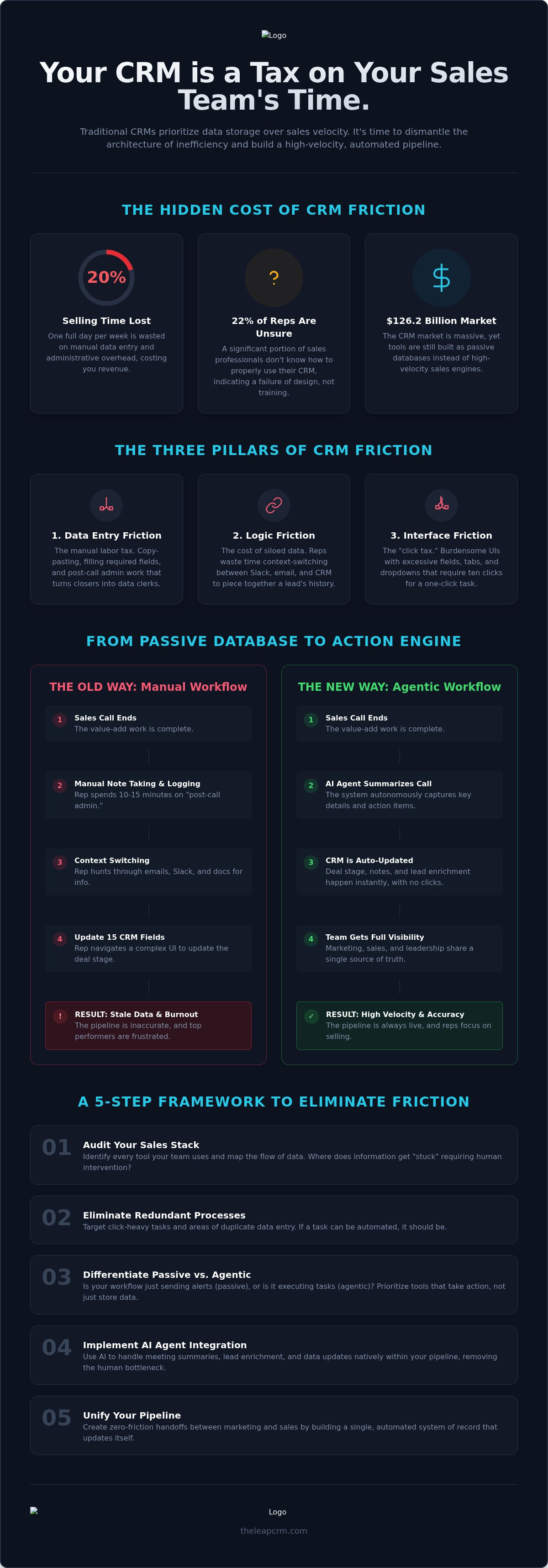
Your CRM isn't a database. It's a tax on your sales team's time. If your reps spend more hours logging calls than making them, your sales architecture is broken. Traditional systems prioritize storage over speed. They demand manual labor. They create silos. By 2026, the global CRM market will hit $126.2 billion, yet 22% of sales professionals still aren't sure how to use their own tools. This is a failure of logic, not a lack of training.
You already know the frustration of inaccurate pipeline data and the lag of manual entry. It's time to stop the context switching between ten different tools. This guide provides a no-nonsense framework to reduce CRM friction by identifying hidden bottlenecks in your sales stack. We'll show you how to implement AI agent integration to build a system that updates itself. You'll gain total pipeline visibility and zero-friction handoffs between marketing and sales. It's time to move from a passive repository to a high-velocity automated pipeline.
Key Takeaways
- Stop paying the "manual labor tax" by identifying where your CRM is draining 20% of your team's active selling time.
- Learn to differentiate between passive data storage and agentic workflows that execute tasks rather than just sending alerts.
- Implement a no-nonsense 5-step framework to audit your sales stack and reduce CRM friction by eliminating redundant, click-heavy processes.
- Master the transition from siloed logic to a unified pipeline where AI agents handle meeting summaries and lead enrichment natively.
- Discover why 2026 sales velocity requires an architectural shift toward systems that prioritize action over documentation.
What is CRM Friction and Why is it Killing Your Revenue?
CRM friction is the resistance between a sales action and its digital record. The sludge in your engine. A rep closes a call. The work should be done. Instead, they face a wall of fields. Dropdowns. Mandatory notes. This gap is a structural failure. Modern Customer Relationship Management (CRM) systems were designed to store data, not to facilitate sales velocity. They act as digital filing cabinets that demand your time without giving anything back.
Consider the "Hidden Tax." Manual updates cost teams over 20% of their potential selling time. That is one full day every week lost to administrative overhead. This is why efforts to reduce CRM friction often fail; they treat the symptom rather than the cause. Friction is an architectural choice. If your system requires human intervention to stay accurate, you have chosen friction over flow. You've prioritized the database over the deal.
The emotional cost is even higher. Top performers don't quit because they can't sell. They quit because they are tired of "feeding the beast." CRM avoidance is a rational response to a tool that provides no value to the user. It creates resentment. It fuels burnout. It builds a culture where data entry is a chore to be avoided, not a resource to be leveraged.
The Symptoms of a High-Friction Sales Stack
You can see the rot in the numbers. High-friction environments produce specific, predictable failures that drain your bottom line:
- Stale deal stages: Pipelines that haven't moved in weeks. The "real" conversation happened on a call, but the CRM was never updated.
- Shadow spreadsheets: Reps keeping private trackers. They do this because the main system is too slow to use as a daily workflow tool.
- Blind management: Leaders making decisions based on incomplete or three-week-old data. It's guesswork disguised as analytics.
The 2026 Reality: Why Legacy Tools Failed
Legacy systems were built as passive repositories. In 2026, a passive repository is a liability. The "Feature Bloat" trap has made things worse. Vendors add more buttons and more tabs, yet they rarely add clarity. These tools demand your attention. They don't earn it. Even integrations often backfire. Instead of syncing data, they create noise and duplicate records. To reduce CRM friction, you must move beyond the database mindset. You need an action engine that works as fast as your best closer.
The Three Pillars of CRM Friction (and How They Kill Productivity)
Friction isn't a minor inconvenience. It's a structural blockade built on three distinct pillars. These pillars don't just slow you down; they stop you. They create a "velocity ceiling" that prevents startups from scaling. To reduce CRM friction, you must dismantle the infrastructure of inefficiency. You can't fix a broken architecture with a better training manual.
The three pillars are clear and destructive:
- Data Entry Friction: The manual labor of "feeding the beast." This is the tax paid in minutes and clicks for every interaction.
- Logic Friction: The cost of siloed information. It requires human brains to translate data between tools because the systems don't talk.
- Interface Friction: The "click tax." This is the result of a UI that forces ten clicks for a single strategic update.
When these pillars stand, your sales team isn't selling. They're performing data entry. They're hunting for context. They're fighting the software instead of the competition.
Data Entry: The Silent Killer of Sales Momentum
Copy-pasting from an email to a CRM in 2026 is an architectural joke. It's a waste of high-value human cognitive energy. Yet, most legacy platforms still require it. "Required fields" are the worst offenders. They don't ensure data quality; they ensure team frustration. When a rep is forced to fill 15 fields to move a deal, they don't provide accuracy. They provide the bare minimum to bypass the gate. The result is a database full of noise. The psychological weight of the "Post-Call Admin" hour kills momentum. It turns closers into data clerks.
Logic Silos and Context Switching
Your CRM is deaf and blind to your actual work. It doesn't know what happened in Slack. It has no record of the Zoom breakthrough. This creates a "logic silo" where the most valuable context lives outside the system of record. Reps spend hours "re-learning" a lead's history before every follow-up call. They hunt through threads. They check calendars. They scan notes. This context switching is a productivity drain that no amount of "intuitive tools" can fix. Most teams just need to simplify. This is why startups need a minimalist CRM that prioritizes logic over bloat.
When logic is siloed, your data is always behind the reality of the market. You can't lead a high-velocity team with a rearview mirror. You need a system that captures logic as it happens. If you want to reduce CRM friction, you must eliminate the need for human translation. You can start by exploring pipeline management tools built for speed, not storage.
Manual vs. Agentic CRM Workflows: A Performance Comparison
Legacy systems treat AI as a decorative feature. They provide alerts. They offer suggestions. They still wait for you to do the heavy lifting. Agentic workflows represent an architectural shift. These are autonomous AI agents that execute tasks, not just provide notifications. To reduce CRM friction, you must stop being a data clerk. You must become a strategic pilot. This is the difference between a system that records history and one that creates it. It's the end of the manual era.
The comparison is stark. Manual workflows rely on human memory and repetitive clicks. Agentic workflows rely on native logic and automated execution. When your CRM acts as an agent, it doesn't just store the meeting summary; it writes it, tags the stakeholders, and sets the follow-up task without a single prompt. This is how you achieve zero-friction management. You remove the human bottleneck from the digital record.
Lead Enrichment: Manual Research vs. Autonomous Agents
The manual research model is a productivity sinkhole. A typical rep spends 15 minutes per lead hunting through LinkedIn, Google, and corporate news cycles before making a first touch. That's 25% of an hour wasted on data gathering. Agentic systems perform instant, multi-source enrichment the moment a lead enters the system. AI Agent integration is the infrastructure of modern sales. It ensures your team starts every conversation with full context, zero research, and absolute precision. You don't hunt for data; the data waits for you.
Pipeline Management: Passive Tracking vs. Active Optimization
Traditional pipeline management is reactive. You look at a dashboard to see what went wrong last week. It's a digital rearview mirror. Active optimization uses agents to move deals forward by suggesting or executing the next best action in real-time. They draft follow-ups based on call sentiment. They update deal stages based on actual calendar events. They flag stalled deals before they turn into lost revenue. If you want to scale, you need to know how to build a sales pipeline that works in an automated environment. Passive tracking is for accountants. Active optimization is for high-velocity closers.
This shift allows you to reduce CRM friction by delegating the "administrative sludge" to the machine. Your reps focus on the high-leverage work of closing deals and building trust. The CRM becomes an invisible partner that maintains the integrity of your data while your team maintains the momentum of your revenue.
A 5-Step Framework to Audit and Eliminate CRM Friction
Don't just "clean your data." That is a reactive cycle that never ends. You need a proactive framework to identify and destroy the barriers to sales velocity. To reduce CRM friction, you must audit the infrastructure itself. This isn't about better habits. It's about better logic. Most teams are buried under legacy sludge because they value documentation over movement. Stop the cycle.
Step 1 & 2: The Friction Audit
Start by interviewing your high performers. Don't ask what features they want. Ask what tasks they hate. Map the journey from lead capture to closed-won with visceral detail. Count the clicks. Every manual update is a potential for error and a tax on time. Look for the dead ends. If a rep enters data that never reaches a dashboard or a strategy meeting, you are wasting human capital on digital landfill. Identifying where data goes to die is the first step toward a lean architecture.
Steps 3-5: The Clean-Up and Automation Phase
Simplify your schema immediately. Kill every field that isn't driving a critical report. If you haven't used a data point for a quarterly review in six months, it's noise. Adopt the "Rule of One": one source of truth, one location for action. This is where you deploy agentic automation. Start with the low-value, click-heavy tasks. Let AI agents handle lead enrichment and meeting summaries natively. This allows you to reduce CRM friction without forcing a total workflow overhaul. The agents act as silent partners that maintain the system while the reps maintain the momentum.
Finally, shift your KPIs. Stop measuring "activity" and start measuring "velocity." If your team is making 100 calls but deals are stalling in Stage 2 because of admin lag, you aren't winning. High-velocity teams prioritize pipeline speed over call volume. They use tools that move as fast as their best closers. Ready to audit your stack? Deploy The Leap CRM to automate your pipeline natively.
Establish a permanent feedback loop to catch new friction before it scales. If a new integration adds three steps to a workflow, it must add 3x the value. If it doesn't, cut it. Your CRM should be a high-performance engine, not a weight your team has to drag through every deal cycle. Keep the logic simple. Keep the movement fast.
Scaling Without the Sludge: The Leap CRM Approach
The Leap CRM is not another database with a fresh coat of paint. It's a system built natively for the agentic era. Legacy platforms were designed to hold data; The Leap CRM was designed to move it. By integrating AI agents into the core infrastructure, we eliminate the need for manual entry at every stage of the funnel. This is the only way to truly reduce CRM friction at scale. You don't need more fields. You need more flow.
A modern sales stack requires a foundation that prioritizes action over documentation. Traditional systems force your team to act as translators between reality and the digital record. The Leap CRM removes this burden. It provides total pipeline visibility with real-time tracking tools that update themselves. When your CRM is friction-free, your team can focus on the high-leverage work of closing deals instead of the low-value work of feeding a machine. It's about radical efficiency.
Architecture Built for Velocity
The Leap CRM treats every data point as an opportunity for automation. Our cloud-based, minimalist design doesn't just store information; it applies logic to it. We use a "Logic-First" approach to sales pipelines. If a meeting occurs, the system knows. It summarizes the transcript, updates the deal stage, and alerts the right stakeholders. This isn't a series of disconnected integrations. It's a native, unified architecture built for startup velocity. It scales with your team without adding the administrative sludge that kills growth. Logic replaces labor.
Your Next Move: Kill the Friction
Stop settling for a CRM that acts like a digital filing cabinet. A stagnant database is a liability. In 2026, the competitive advantage belongs to those with a zero-friction sales engine. You've identified the bottlenecks. You've seen the performance gap between manual and agentic workflows. Now, you must choose the infrastructure that supports your ambition. Settling for "good enough" tools is a choice to slow down. Don't make it.
The Leap CRM is the last sales platform you'll ever need. It replaces the "data entry" mindset with an "automated pipeline" reality. It's time to stop fighting your tools and start using them to win. Experience the future of sales with The Leap CRM and reduce CRM friction for good. Efficiency isn't a goal; it's a requirement. Build your foundation on logic, not labor. Move fast. Scale clean.
Build for Velocity, Not Documentation
CRM friction is an architectural choice. If your team is stuck in a manual entry loop, you've chosen to lose velocity. You've seen the framework. You know the cost of the "hidden tax." By 2026, the global CRM market will be massive, yet most systems remain digital filing cabinets. To reduce CRM friction, you must move to an agentic model. This means AI agents that execute tasks, not just send alerts. It means a system that maintains its own integrity while you focus on closing deals.
High-performance startup teams don't have time for administrative sludge. You need a foundation built for speed. The Leap CRM offers an AI-native architecture designed specifically to eliminate the manual burden. It turns your pipeline from a passive record into a high-velocity action engine. Focus on the strategy. Let the agents handle the documentation. Stop the data entry grind. Start selling with The Leap CRM. It's time to build a sales engine that works as hard as you do. Own your data. Own your growth.
Frequently Asked Questions
What is the primary cause of CRM friction?
The primary cause is architectural debt within systems designed for data archival rather than sales velocity. Most platforms prioritize the digital paper trail over the actual momentum of a deal. This creates a structural mismatch where the tool demands more energy than it provides in return. When the cost of documentation exceeds the benefit of the insight, friction becomes the default state of the sales stack.
How can I reduce CRM friction without changing my entire software stack?
You can reduce CRM friction by aggressively pruning your data schema and automating the lowest-value tasks. Audit every required field and delete those that do not directly influence your quarterly revenue reports. Implement logic layers that handle basic field mapping between your communication tools and your database. This minimizes the "click tax" without requiring you to migrate your entire historical data set to a new platform.
Do AI agents actually work for CRM automation?
Agentic workflows represent a shift from notification-based AI to execution-based logic. These agents don't just alert you to a stalled deal; they draft the re-engagement sequence based on previous sentiment and set the task for your review. They handle the enrichment, tagging, and summaries that usually drain sales momentum. By performing these tasks autonomously, they maintain the integrity of your pipeline without requiring manual human intervention.
How much time can a sales team save by reducing CRM friction?
Sales teams typically reclaim approximately 20% of their active selling hours by eliminating the administrative sludge of manual entry. For a standard high-performance team, this translates to an extra 40 to 50 hours of high-leverage work per rep every month. This isn't just about saving time; it is about reallocating human cognitive energy from data entry to discovery calls, negotiation, and building trust with prospects.
What is the difference between a traditional CRM and a friction-free CRM?
A traditional CRM acts as a passive ledger that requires constant human maintenance to remain accurate. It is a digital filing cabinet. In contrast, a friction-free system like The Leap CRM is an active engine that executes administrative tasks autonomously. The Leap CRM prioritizes action over documentation, ensuring that the digital record is a byproduct of the sales process rather than a separate, manual chore for the sales rep.
How do I know if my CRM is too complex for my team?
Complexity is visible in the presence of "shadow systems" like private spreadsheets or sticky notes. If your reps don't treat the CRM as their primary source of truth for daily tasks, the system is failing. High complexity leads to "CRM avoidance," where data is only entered at the end of the month to satisfy management. If the software feels like a hurdle instead of a tool, it is over-engineered.
Can reducing CRM friction improve lead conversion rates?
Reducing friction directly impacts your "speed to lead" and follow-up precision. When automation handles enrichment and meeting summaries, reps can engage with prospects near-instantly using high-context information. This eliminates the research lag that often causes deals to go cold. A more responsive sales team, supported by a system that maintains itself, naturally achieves higher trust and improved conversion rates across every stage of the funnel.
What are the first steps to auditing my sales workflow for friction?
Conduct a "click-count" audit of your entire lead-to-close journey. Identify every manual step that does not involve a human-to-human conversation. Ask your team which specific fields they find most redundant or frustrating to fill. Once you map these "dead ends" where data entry provides no tactical value, you can begin the process to reduce CRM friction by targeting those specific bottlenecks for removal or automation.

