

Your legacy CRM is likely a graveyard for productivity. It's a heavy, outdated anchor dragging behind a sales team that needs to move at light speed. Most platforms weren't designed for scale. They were designed for middle management reporting. If your reps are losing four hours a day to manual data entry, you don't have a sales tool. You have a data entry bottleneck. Selecting a CRM for fast growing startups is no longer about basic contact storage. It's about engineering a high-velocity revenue engine.
We understand the friction of fragmented pipeline visibility and software bloat. You hired closers, not administrators. This guide will show you how to stop fighting your software and start closing deals with a CRM built for high-growth speed. We'll explore the logic of total pipeline visibility, the mechanics of automated lead management, and the architecture of a system that reps actually love using. It's time to replace administrative debt with architectural soundness.
Key Takeaways
- Stop paying the "Admin Tax" to legacy systems that function as glorified digital filing cabinets instead of growth engines.
- Implement the five core infrastructure requirements for a CRM for fast growing startups to ensure your software scales with your headcount.
- Shift from vanity volume metrics to high-velocity pipeline movement by visualizing and eliminating deal-killing bottlenecks.
- Leverage AI agents for autonomous lead qualification and enrichment, effectively ending the era of manual data entry.
- Transition from complex, bloated software to a streamlined, utilitarian platform built for architectural soundness and speed.
The Legacy CRM Trap: Why Startups Stall at Scale
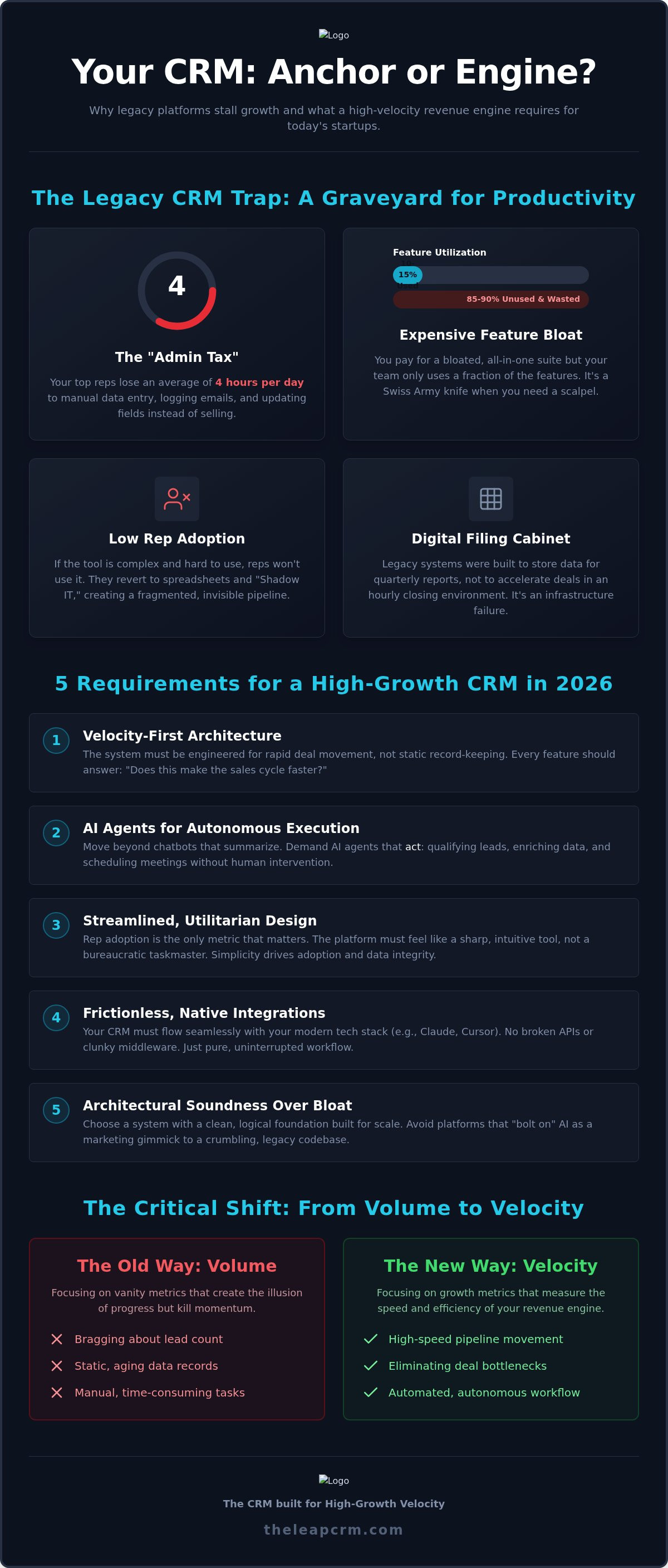
Traditional software is a liability. It's a digital filing cabinet that stores data but kills momentum. Most legacy platforms were built for the era of quarterly reporting, not the era of hourly closing. This is the "Admin Tax." It's the four hours your top reps spend manually logging emails and updating fields instead of talking to prospects. When you choose a Customer relationship management (CRM) system, you aren't just buying a database. You're choosing the speed at which your company can move. Selecting a CRM for fast growing startups is a survival decision.
Complexity creates friction. Friction kills growth. Startups don't have the luxury of slow cycles or "all-in-one" platforms that claim to do everything but master nothing. These generalist tools are usually mediocre at sales, marketing, and support simultaneously. For a high-growth team, mediocrity is a death sentence. You need a tool that does one thing with technical precision: move deals through the pipeline.
The High Cost of Feature Bloat
You are likely paying for 90% of features your team will never touch. Legacy vendors sell you a Swiss Army knife when you need a scalpel. Implementation cycles for these bloated systems take months. By the time the tool is "ready," your startup has already evolved past its initial requirements. Then there is the hidden cost of the "CRM Administrator." If you need a full-time hire just to manage the software that is supposed to manage your sales, the architecture is broken. It's an infrastructure failure that drains your capital and your time.
Why Rep Adoption is the Only Metric That Matters
If the tool is hard to use, they won't use it. It's that simple. When a CRM for fast growing startups feels like a chore, reps retreat to "Shadow IT." They go back to spreadsheets. They keep notes in Slack. They hide data in their heads. This creates a fragmented pipeline where leadership has zero visibility. You can't build a data-driven culture on a foundation of user resentment.
High-velocity sales requires a system that feels like a tool, not a taskmaster. Rep adoption isn't a "nice to have" metric; it is the only metric that determines if your investment is generating revenue or just collecting digital dust. Build a culture of data-driven sales through simplicity, logic, and speed. Anything else is just noise.
Choosing Your Engine: 5 Requirements for Startup CRM in 2026
Stop building on sand. Start building on logic. In 2026, a CRM isn't a database; it is a high-performance engine. Most legacy vendors try to hide their aging codebases by "bolting on" AI features as an afterthought. This is a facade. Finding the right CRM for fast growing startups requires looking past the marketing gloss and inspecting the underlying architecture. You need speed, precision, and autonomy. You need a system where automation is the core, not a plugin.
A velocity-first architecture is non-negotiable. This means the system is designed for rapid deal movement rather than static record keeping. Recent market reports indicate that 85% of small and medium-sized businesses using AI see measurable improvements in how their sales reps use their time. This efficiency only happens when the AI is baked into the foundation. Finally, your stack must be frictionless. Your sales tool should integrate natively with Claude, Cursor, and your entire modern development environment. No custom middleware. No broken APIs. Just flow.
Step 1: Audit Your Sales Reps Workflow
Identify the friction. Map the journey from the first lead touch to the final closed-won notification. You will likely find a graveyard of manual tasks. Every minute spent on data entry is a minute stolen from closing. Audit the workflow to find where the "Admin Tax" is highest. Eliminate every non-selling task. If a human has to type a phone number or copy-paste an email address, your process is failing. If you are ready to stop the manual grind, check out how The Leap CRM Platform automates these workflows natively.
Step 2: Prioritize AI-Driven Automation
Distinguish between conversation and execution. Most platforms offer "chatbots" that just summarize text. You need AI agents. These agents don't just talk; they act. They schedule meetings. They perform lead enrichment. They follow up based on specific sales business rules. Verify that the AI can handle complex logic without human intervention. The goal is autonomous lead qualification. Selecting a CRM for fast growing startups means choosing a partner that executes your strategy at scale. Build for velocity. Build for the future.
Pipeline Management: Turning Volume into Velocity
Volume is a vanity metric. Velocity is a growth metric. Most startups brag about lead count. Smart startups track how fast those leads turn into revenue. If your pipeline is a black hole where deals sit for weeks, you don't have a sales process. You have a storage problem. A CRM for fast growing startups must be a conduit, not a container. It shouldn't just hold data; it should accelerate it through the funnel with technical precision.
Visualizing bottlenecks is the first step toward fixing them. Where do deals go to die? Is it the proposal stage? The legal review? Is a specific rep struggling with the transition from discovery to demo? Without real-time visibility, you're guessing. You're making decisions based on "gut feel" instead of hard infrastructure. Automated deal tracking removes the burden from the rep. It lets the software do the heavy lifting of status updates and activity logging. This leads to cleaner data and predictive analytics that actually mean something for your MRR forecasting. When the data is clean, the future is predictable.
The Anatomy of a High-Performance Pipeline
Start with logic. Define clear, automated stage transitions. If a meeting is booked, the deal moves. If a contract is sent, the stage updates. Use "Stale Deal" alerts to maintain momentum. If a prospect hasn't been touched in 48 hours, the system should flag it immediately. This isn't micromanagement. It is architectural soundness. It allows leadership to use real-time data to coach reps on specific deals before they're lost. You move from reactive post-mortems to proactive deal-saving interventions. Precision beats effort every time.
Scaling Your Revenue Engine
Standardization is the only way to scale. You need to onboard new reps in hours, not weeks. A logical CRM provides the blueprint. It tells the rep exactly what to do next. As you double your headcount, maintaining data integrity becomes a war. You win that war with automation, not manual oversight. By standardizing the sales process, you create predictable outcomes. You move from a collection of "star players" to a repeatable revenue engine. This is how you scale from 10 to 100 people without the wheels falling off. You don't need more managers. You need better infrastructure.
The End of Data Entry: How AI Agents Transform Sales
Legacy automation is a series of brittle "if-this-then-that" statements. It breaks when the real world gets messy. AI agents are different. They reason. They adapt. They execute. For a CRM for fast growing startups, this shift from passive storage to active agency is the difference between a tool that records history and one that creates it. AI Agent Integration allows your system to handle lead enrichment and qualification autonomously. It doesn't just wait for data; it goes out and finds it. It verifies the LinkedIn profile. It checks the latest funding round. It qualifies the lead before a human ever sees it.
Every sales call is now a primary data source. Real-time recording and transcription turn spoken words into structured pipeline intelligence. You no longer rely on a rep's memory or their willingness to type. The system hears the objection, logs the competitor mentioned, and updates the deal score instantly. Follow-ups are drafted immediately, sounding human because they are based on the actual conversation, not a generic template. This is the end of the manual era. It is the beginning of the autonomous era.
Give Your Reps 4 Hours Back Daily
Reps are hired to close, not to type. When AI agents handle CRM updates while reps are still on the call, the "Admin Tax" disappears. Meeting summaries and action items are generated in seconds. Zero-Touch CRM is the 2026 standard where the software adapts to the human; it describes a system where data entry is fully automated and invisible to the user. By removing the burden of manual entry, you allow your team to focus on high-leverage activities. They spend their time talking. They spend their time closing. They spend their time winning. Radical efficiency is the only way to scale without burning out your best talent.
Beyond Chatbots: Strategic AI Execution
Chatbots are for basic inquiries. Sales teams need execution agents. These agents identify the "next best action" for every deal based on historical win patterns. They perform automated sentiment analysis on prospect emails to flag deals that are cooling off before it's too late. This allows you to scale personalization without increasing your headcount. You get the output of an army with the overhead of a squad. You aren't just adding a plugin; you are upgrading your revenue infrastructure. If you want to see this logic in action, explore how The Leap CRM Platform integrates these agents directly into your sales infrastructure. Stop managing data and start managing momentum.
The Leap CRM: Built for High-Growth Velocity
The search for the right infrastructure ends here. You don't need another digital filing cabinet. You need a revenue engine. The Leap CRM Platform is the logical conclusion for leadership teams tired of fighting their own software. It is a system built on modern logic, designed to replace the legacy bloat that currently slows your velocity. While traditional vendors sell you a maze of menus, we provide a straight line to the close. Choosing a CRM for fast growing startups shouldn't feel like a compromise between power and simplicity.
Onboarding should respect your clock. We've eliminated the six-month implementation cycle. Our architecture allows for rapid deployment, ensuring your team is closing deals within days, not weeks. This is our "No Fluff" promise. We only provide the tools you need to grow. If a feature doesn't directly contribute to moving a deal through the pipeline, it doesn't belong in your workspace. Our platform is the definitive CRM for fast growing startups that value substance over style. You aren't just buying software; you're investing in a scalable sales methodology.
Unapologetic Efficiency
Minimalist design. Maximum output. The UI is a study in radical efficiency. It removes the noise so your reps can focus on the signal. Our native AI Agent Integration is built into the foundation, providing autonomous lead enrichment and qualification from day one. This isn't just software for today. It is infrastructure built to scale with your Series B, your Series C, and your eventual IPO. It is stable. It is fast. It is architecturally sound. We focus on the logic of the deal so you can focus on the relationship.
Take the Leap
Stop being a data entry clerk. Your talent is too expensive for manual logging. Reclaim your sales team’s time and redirect it toward high-leverage conversations. You've seen how legacy systems kill velocity. Now, see how a high-performance tool accelerates it. Start your high-velocity growth with The Leap CRM. It is the last sales platform you will ever need. Build for speed. Build for scale. Build for the win.
Engineer Your Revenue Engine
Legacy debt is a choice you can no longer afford. Traditional software stalls momentum; modern infrastructure accelerates it. High-growth velocity requires a transition from passive record-keeping to active sales execution. By implementing AI-native logic and automated pipeline tracking, you remove the friction that kills deals. Selecting a CRM for fast growing startups is the most critical architectural decision your leadership team will make this year.
The Leap CRM is built for the 2026 sales environment. Our AI agents handle 90% of routine CRM admin tasks, effectively freeing your reps from the keyboard. With native integration for modern tools like Cursor, it slots directly into your existing high-velocity stack. Stop fighting your tools. Start closing deals. Stop the data entry grind. Get The Leap CRM. You've built a great product. Now, give it the revenue engine it deserves.
Frequently Asked Questions
Why do most startups fail with traditional CRMs?
Most startups fail because traditional systems prioritize reporting over revenue. These platforms act as digital filing cabinets that demand constant manual entry. Reps end up losing hours to administrative tasks instead of closing deals. This creates avoidable friction. When a CRM for fast growing startups is too complex, adoption drops. Reps revert to spreadsheets. The system becomes a graveyard for data rather than an engine for growth.
What makes a CRM "AI-native" rather than just having AI features?
Native AI is built into the foundational architecture; it isn't a bolted-on plugin. In an AI-native system, agents autonomously handle lead enrichment, qualification, and data logging as core functions. Traditional systems often add "chatbots" as an afterthought. Our AI Agent Integration reasons through sales logic to execute tasks. It identifies the next best action and automates follow-ups based on real-time call transcriptions. It is proactive, not reactive.
How does The Leap CRM handle pipeline visibility for remote teams?
Visibility is maintained through real-time, automated deal tracking that eliminates the need for manual status updates. Remote teams often suffer from fragmented data. The Leap CRM provides a single source of truth by logging every interaction automatically. Managers see exactly where deals stall without nagging reps for updates. Our Pipeline Management Tools use logic-driven stage transitions. This ensures every team member sees the same high-velocity revenue engine.
Can I migrate my existing data from HubSpot or other legacy platforms easily?
Yes. We provide streamlined migration paths designed to respect your time. Legacy systems are often designed to keep your data hostage with complex exports and proprietary schemas. We use modern infrastructure to map your existing pipeline stages directly into our utilitarian interface. The goal is to move from legacy debt to streamlined logic without losing historical context. You can transition your entire sales stack to a CRM for fast growing startups in days.
How much time can my sales team really save with AI agents?
Sales reps can reclaim up to four hours of their day by offloading manual data entry to AI agents. These agents handle the majority of routine administrative tasks, including meeting summaries and action item generation. This isn't a vague estimate; it is a benchmark for modern sales environments. By eliminating the need to type out call notes or manually update fields, your team focuses entirely on high-leverage closing activities and revenue generation.
Does The Leap CRM support custom sales workflows for niche industries?
Absolutely. While we provide a minimalist UI, the underlying logic is highly adaptable. You can define custom stage transitions and automated triggers that match your specific business rules. We avoid the "all-in-one" trap by focusing strictly on sales velocity. Whether you are in deep tech or fintech, our infrastructure scales with your complexity. We provide the architectural soundness needed to standardize niche processes for predictable, repeatable outcomes at any scale.
Is a minimalist CRM better than an all-in-one platform for scaling?
Yes. All-in-one platforms are usually mediocre at everything. They create system bloat that reps refuse to use. A minimalist CRM focuses on the only metric that matters: deal velocity. You need a tool that does one thing with technical precision. Minimalist design doesn't mean fewer capabilities; it means zero noise. It allows your team to move faster, onboard quicker, and maintain data integrity as you scale toward your Series B and beyond.

