

Sales reps currently waste 71% of their time on non-selling tasks like manual data entry. It's a drain on growth. It's a waste of talent. You likely invested in small business sales pipeline software to gain clarity, yet you ended up with a digital filing cabinet that requires constant feeding. You're tired of fragmented data, complex interfaces, and high costs for features that sit idle. Most systems today are passive repositories that demand your attention without offering a return on your effort.
You know the status quo is broken. This article will show you how to stop managing databases and start building an autonomous sales engine that actually closes deals. We'll preview the 2026 high-velocity tech stack, explore the shift toward agentic AI, and outline the path to total pipeline visibility. We're moving beyond legacy assistants into a world of native technological integration. It's time to spend less time clicking and more time selling.
Key Takeaways
- Shift from passive databases to autonomous execution infrastructure. Stop acting like a data entry clerk and start acting like a closer.
- Benchmark your small business sales pipeline software against the 2026 AI-native standard to eliminate the 71% of time wasted on admin.
- Distinguish between native AI agents that perform the work and legacy assistants that only offer suggestions. Architecture matters more than features.
- Prioritize architectural logic over feature bloat. Build a scalable sales engine that values your time and drives high-velocity growth.
The Failure of Traditional Small Business Sales Pipeline Software
Traditional CRM is a digital graveyard. It was designed for middle management to pull reports, not for sales teams to win deals. Most small business sales pipeline software operates as a passive database. It waits for you to feed it. It demands manual updates. It provides zero momentum. This architecture is a relic of a slower era. By 2026, the era of the passive database is officially over.
Legacy tools prioritize oversight over execution. They value the manager's need for a chart over the seller's need for speed. This hierarchy is inverted. In a high-velocity environment, the tool must serve the execution. It should be invisible, functional, and fast. Instead, traditional software is loud, cumbersome, and slow. It's time to stop fighting your tools and start using infrastructure that works.
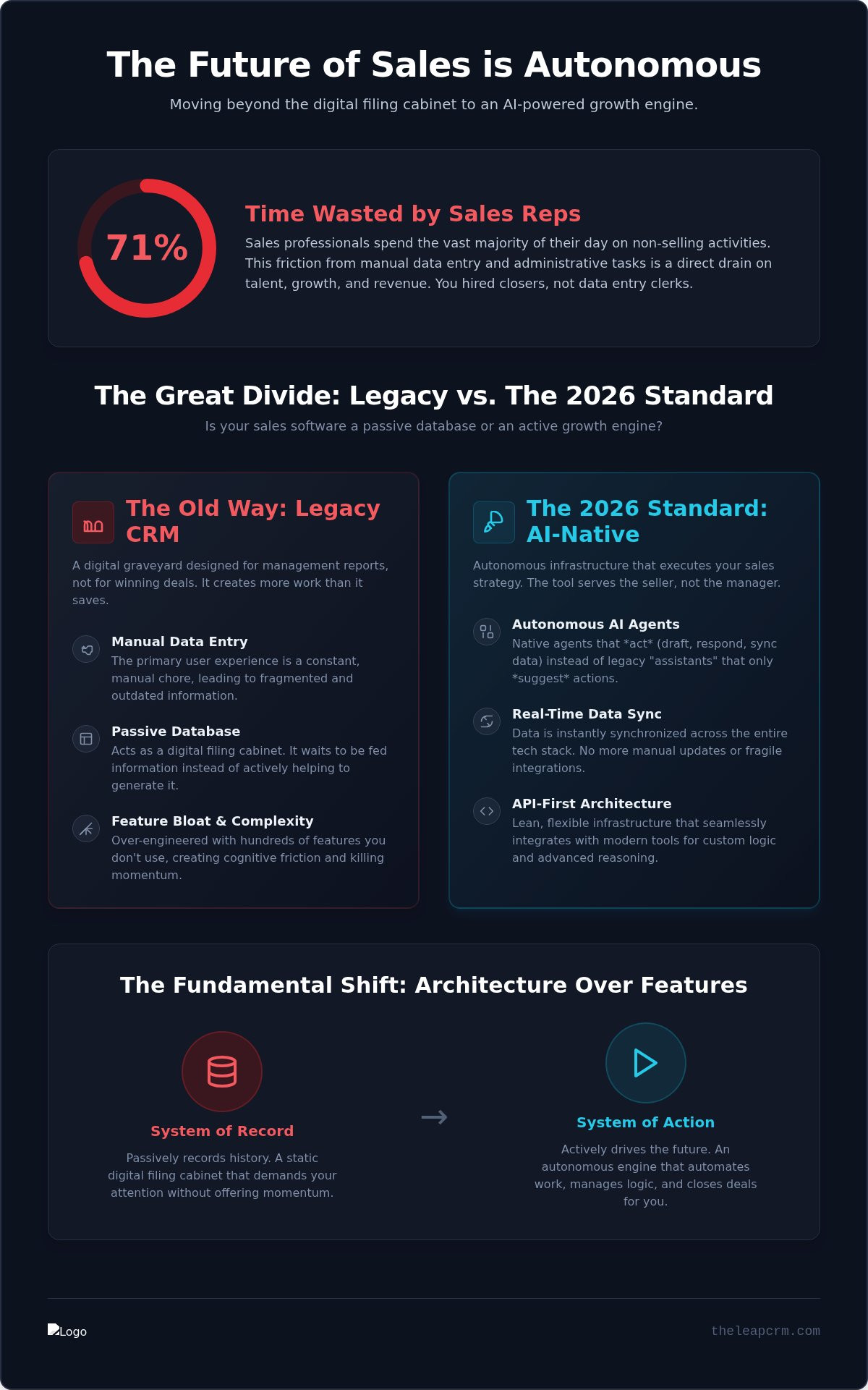
The data entry trap is real. Sales reps currently spend 71% of their time on non-selling tasks. That's four hours every day lost to administrative friction. You hired closers, but you're paying them to be data entry clerks. This manual approach to the sales process is why your revenue is stagnant. It's a failure of logic. It's a failure of infrastructure. Traditional software failure points include:
- Reporting-first design that ignores seller workflow.
- Manual data entry as the primary user experience.
- Fragile integrations that break under real-world load.
The Bloatware Tax on SMB Growth
Feature bloat is a hidden tax on your team’s productivity. You pay for a hundred features. You use five. The remaining 95 aren't just useless; they're obstructive. They create cognitive friction. Every extra button, tab, and menu item is a distraction. Complex interfaces kill sales momentum. Small businesses don't need "all-in-one" solutions that do everything poorly. They need lean infrastructure that executes with precision. Speed matters. Clarity matters. Results matter.
Why Small Businesses Abandon CRM Systems
Adoption rates for traditional systems are abysmal. Most small businesses abandon their small business sales pipeline software within the first year. Why? Because the software is over-engineered. It creates more work than it saves. There's no immediate ROI in manual tracking systems. If a tool takes more time to update than it saves in execution, it's a liability.
The market is shifting. We're moving from a System of Record to a System of Action. A System of Record just sits there. It records history. A System of Action drives the future. It automates the grunt work. It manages the logic. It closes the deal. Modern teams demand autonomous engines, not digital filing cabinets. The transition is inevitable. The old way is dead.
What is Sales Pipeline Software in 2026? (The AI-Native Standard)
2026 has redefined the category. Modern small business sales pipeline software is no longer a tool for recording history. It is a centralized infrastructure for autonomous sales execution. Most legacy systems offer "AI assistants" which are essentially chatbots that suggest actions you still have to take. Modern systems use native AI agents. Agents don't suggest. They act. They draft, they respond, and they synchronize data across your entire stack without being asked.
Architectural integrity matters. Bolted-on AI is a patch on a sinking ship. Native AI is the hull. This distinction determines whether your team spends their day managing software or closing deals. Real-time data synchronization across every tool is now a baseline requirement. If your CRM doesn't update your communication channels and lead scores instantly, it's already obsolete. Automated customer interaction is no longer a luxury feature; it's a core platform requirement for survival.
From Passive Database to Autonomous Infrastructure
Cloud-native in 2026 means more than browser accessibility. It means an environment that learns from your sales cycle in real-time. These systems analyze every interaction to refine the process of building a successful sales pipeline. AI agents handle the routine tasks that kill momentum: lead scoring, follow-ups, and meeting scheduling. They operate within your defined logic. They never forget. They never sleep. They turn your strategy into a constant, moving force.
The 2026 Sales Tech Stack Essentials
Modern infrastructure requires an API-first architecture. It must integrate seamlessly with tools like Cursor for custom logic or Claude for advanced reasoning. This allows for lean, custom workflows that adapt to your specific market conditions. An AI-native CRM is a self-executing sales engine. It converts strategy into action without human intervention at every minor step. If you're ready to move beyond legacy limitations, exploring AI-driven pipeline management is the logical next step for any high-growth team.
Your tech stack should be a competitive advantage, not an administrative burden. In 2026, the winner isn't the company with the most features. It's the company with the most efficient logic. Small business sales pipeline software must be lean, fast, and autonomous. Anything less is just a digital filing cabinet.
Evaluating Bloat vs. Lean Sales Infrastructure
Legacy tools are heavy. They're slow. They're built on the assumption that you have an army of administrators to manage them. For a growing company, this is a death sentence. When evaluating small business sales pipeline software, you must ignore the feature list. Features are cheap. Logic is expensive. You need to standardize your search around three metrics: Velocity, Friction, and Value. Velocity is the speed of a deal through the cycle. Friction is anything that slows down the seller. Value is the actual revenue generated per hour of effort.
Don't be fooled by "user friendly" interfaces. A pretty dashboard that still requires ten clicks to update a status is just a polished burden. You need "user efficient" infrastructure. Efficiency means the software anticipates the next move. It removes the need for manual input. Understanding what is a sales pipeline is foundational, but your infrastructure should execute that pipeline, not just display it. Every extra button is a distraction. Every unnecessary menu is a delay.
The Time-to-Value Framework
Ask one question: How many clicks does it take to move a deal? If the answer is more than zero for routine updates, your software is failing you. Automation depth is the differentiator in 2026. A legacy system sends you a reminder to follow up. A modern system sends the follow-up for you. It drafts the email, checks the calendar, and logs the interaction autonomously. Scalability shouldn't mean hiring more admin staff to manage your tools. It should mean your revenue grows while your overhead remains lean. You want a system that scales without adding complexity.
Comparison: Legacy CRM vs. Modern Infrastructure
The gap between old-world databases and new-world engines is widening. Legacy giants were built for a manual era. Modern AI-native systems are built for autonomy. They prioritize closing over recording.
| Metric | Legacy Enterprise CRM | Modern AI-Native Infrastructure |
|---|---|---|
| Primary Role | Management oversight tool | Sales execution engine |
| Data Entry | Manual and repetitive | Autonomous and invisible |
| Setup Time | Months of configuration | Days of logic mapping |
| AI Integration | Bolted-on "assistants" | Native agentic core |
Setup time is another hidden tax. Legacy platforms require expensive consultants and months of onboarding. Modern cloud platforms are operational in days because they rely on native logic rather than custom-coded bloat. Beware the "Free" tier trap. These entry-level plans often lack the automation required for real growth. They lock your data into a system that eventually forces you into high-cost, feature-heavy tiers you don't need. Choose lean. Choose speed. Focus on closing, not clicking.
Building a High-Velocity Small Business Sales Pipeline
High-velocity growth requires a shift in perspective. You aren't just tracking deals; you're managing a logic-driven system. Building a successful pipeline with modern small business sales pipeline software starts with mapping your sales logic, not your sales history. Most teams document where a lead went wrong after the fact. You need to define the exact sequence of events that leads to a close. Map the triggers. Define the outcomes. Build the infrastructure to support that movement.
To scale, you must follow a structured path of radical efficiency:
- Step 1: Map your sales logic. Define the "if-then" of every deal stage.
- Step 2: Automate the grunt work. Deploy AI agents to handle the repetitive tasks.
- Step 3: Establish total visibility. Use real-time tracking to eliminate blind spots.
- Step 4: Optimize with data. Replace gut feelings with conversion metrics.
- Step 5: Iterate with zero friction. Update your process without breaking your software.
Automating the Sales Workflow
AI agents are the new standard for lead qualification. They handle initial outreach while the lead is still hot. They don't wait for a rep to check their inbox. Response times drop from hours to seconds. This eliminates manual data entry during the deal tracking process. Your small business sales pipeline software should update itself. If a meeting is booked, the status changes. If an email is ignored, the agent follows up. No clicks required.
Real-Time Pipeline Visibility
Static reports are dead. In 2026, a PDF from last Tuesday is useless. You need autonomous health monitors that track deal health in real-time. These monitors flag stalled deals before they die. They ensure every rep knows exactly what to do next. There is no guesswork. There is only execution. You can build your autonomous sales engine today and stop the leak in your revenue.
Data-driven insights replace gut feelings. High-velocity teams analyze conversion rates at every micro-stage. They find the bottlenecks. They fix them. Iterating your process should be seamless. If you need to change a workflow, your software should accommodate it instantly. Zero-friction updates are the hallmark of modern infrastructure. Don't let your tools dictate your strategy; let your strategy drive your tools.
The Leap CRM: Pipeline Architecture for Growth
Traditional software is a burden. The Leap CRM is a tool. It's built for teams that value time over features. Most small business sales pipeline software is bloated with unused code and redundant menus. We stripped that away. We focused on the architecture of the close. This is not a passive database. It is a high-performance engine designed for 2026 velocity. If you're tired of feeding a system that gives nothing back, you're ready for a change.
Modern startups are abandoning legacy bloat. They're tired of paying for features they never touch. They're weary of complex configurations that require expensive consultants. The Leap CRM offers a streamlined alternative. It prioritizes action. It values speed. It respects your time. Our AI agent integration isn't a sidekick; it's the core of the platform. It handles the work you hate. Data entry. Lead scrubbing. Follow-up scheduling. It executes the logic of your sales process while you focus on the relationship.
Precision Sales Tools for Modern Teams
Execution requires focus. Our UI reflects that. It's short, punchy, and built for fast execution. We don't do fluff. We don't do marketing jargon. We do efficiency. This is CRM for fast growing startups who understand that legacy systems kill velocity. It's built by engineers for builders. Every pixel is optimized for movement. Every workflow is designed to eliminate cognitive friction. You need a system that thinks as fast as you do.
Getting Started with The Leap CRM
Migration shouldn't be a project. We've made it a process. Zero-friction migration from legacy systems like HubSpot is a baseline. Your data belongs to you. It should move with you. You can deploy your first AI sales agent in minutes. Not weeks. Not months. You define the logic; the agent executes the task. It's that simple. You've spent enough time clicking and waiting. Stop wasting time on data entry. Start your Leap CRM.
The choice is binary. You can continue managing a digital graveyard, or you can build an autonomous sales engine. The Leap CRM provides the infrastructure. You provide the strategy. Together, they create predictable revenue. It's time to stop recording history and start driving the future. Your team deserves a tool that works as hard as they do. Your business deserves the velocity of 2026.
Deploying Your Autonomous Sales Engine
Traditional databases are dead weight. You've seen why legacy systems fail and how 2026 standards demand agentic AI over passive assistants. Implementing lean small business sales pipeline software isn't just a technical upgrade; it's a strategic pivot toward radical efficiency. You're trading manual friction for architectural speed. You're moving from recording history to executing the future. The era of the digital filing cabinet is over. The era of the self-executing engine has arrived.
The choice is binary. You can stay buried in administrative tasks or leverage AI-Native Architecture to scale your revenue. The Leap CRM provides Zero-Bloat Pipeline Management designed specifically for 2026 Sales Velocity. It's time to stop clicking and start closing deals. Your team is too valuable to spend four hours a day on admin. Eliminate the data entry clerk role. Join The Leap CRM. Your growth is waiting on your infrastructure. Build it today and win tomorrow.
Frequently Asked Questions
Is a cloud CRM secure for my small business data?
Cloud-native architecture provides superior protection compared to legacy systems. We use modern encryption standards to ensure data integrity across the global network. Security is a baseline requirement, not a feature. Your data is isolated in a secure, cloud-based environment. It's protected from local hardware failures and outdated security patches. This architectural soundness ensures your business information remains safe and accessible. Precision matters here.
How long does it take to migrate from legacy systems to The Leap CRM?
Migration is a matter of days, not months. We've built zero-friction importers for legacy data from major traditional platforms. You don't need a consultant. You don't need a six-month roadmap. Map your logic, import your records, start selling. We value your time over complex implementation cycles. The process is direct and utilitarian. You move from old bloat to lean infrastructure quickly.
Do I need a developer to set up AI agents in my CRM?
No. Our AI agent integration is built for builders, not just coders. You define the sales logic through a precise, intuitive interface. The agents execute that logic autonomously without manual coding. It's a configuration task, not a development project. You focus on the sales strategy while the infrastructure handles the technical execution. This approach saves you time and development costs.
What is the difference between a traditional CRM and an AI-native CRM?
Traditional CRM is a passive database. It records history. AI-native small business sales pipeline software is an autonomous engine. It executes tasks. Legacy systems wait for you to type data into boxes. Our system acts on your behalf. One is a digital filing cabinet; the other is a revenue generator. The difference is execution. You need action, not just records.
Can The Leap CRM integrate with tools like Slack and Claude?
Yes. Integration is native and precise. We connect directly with Claude for advanced reasoning and Slack for real-time communication. This creates a unified sales stack without the need for brittle third-party patches. No messy middleware is required. It's a clean, functional, and architectural connection that keeps your team in sync. Your tools should work together as a single, cohesive engine.
How does small business sales pipeline software pricing typically work?
Pricing usually follows a SaaS subscription model. You pay for the platform and the integrated AI capabilities. It's an investment in your sales logic. Avoid complex tiered pricing that charges for unused features. Focus on utility. You're paying for a revenue engine that eliminates manual labor. Radical efficiency has a clear ROI. We value transparency over hidden costs.
What happens if my sales team refuses to use a new CRM?
Reps reject software that feels like a chore. They embrace software that acts like a tool. Adoption is high because we eliminate the data entry tasks they hate. When the system updates itself, there's nothing to resist. It's about serving the seller. Give them back their time, and they'll give you their loyalty. Efficiency is the best adoption strategy.
Is The Leap CRM suitable for B2B sales cycles?
Yes. B2B cycles are often long and fragmented. Our small business sales pipeline software provides the stability needed for these workflows. AI agents manage the persistent follow-ups required in the B2B space. They ensure no lead goes cold during the long journey. You maintain total visibility over complex deals. It's the architectural foundation for scalable, predictable B2B revenue growth.


